Salt Spring Island Archives

The Penn/Braithwaite family has passed down many names, and bore many artists. Below is the history of a family that painted British Columbia and its coast over generations. Most relevant is the painter named Maud Lilian Weaver-Bridgman whose art contributed to Salt Spring’s unique artistic heritage.
Maud Lilian Tyrwhitt-Drake was the second daughter of the Honourable Montague William Tyrwhitt-Drake. She was born in 1858 in Victoria, BC.
Her father Montague was the first of his family to leave England to settle in British Columbia. In 1858, he left home to create a life in BC, departing soon after finishing his Law degree at 30 years old.
Montague was one of the many settlers who left England in rebellion to the Industrial Revolution taking place there. Following philosophers like John Ruskin, they believed there was value in a simpler life of using local materials and crafts, and building relationships with the land. These English men and women left to create “intentional communities” in wild, beautiful settlements like BC. This reaction and relocation was named the “Arts and Crafts Movement”, and was one that changed the social composition of places like Salt Spring Island to what they are today: art-centred communities with strong land relationships.
Montague arrived in California, ‘round the Horn’, a common route taken around America to get to the BC Coast. He tried his luck in the Cariboo Gold Rush, but soon moved on to start a law firm in Victoria. His work took him travelling all around the coast, and he practiced art all the while; documenting his love for the land and his life. He served a term as Victoria’s Mayor, and later went on to become the Supreme Court Judge of British Columbia from 1889 to 1904.
Montague had married Joanna Tolmie (cousin of Dr. Tolmie) in 1862, and they had five children: Mildred Jane, Maud Lilian, Clare Lucy, Brian Halsey, and Helen Louise. The Tyrwhitt Drakes had lived near Point Ellice Bridge on the inner harbour, and later the family moved to Oak Bay. His daughter Maud introduced the family to Salt Spring Island in her later years.
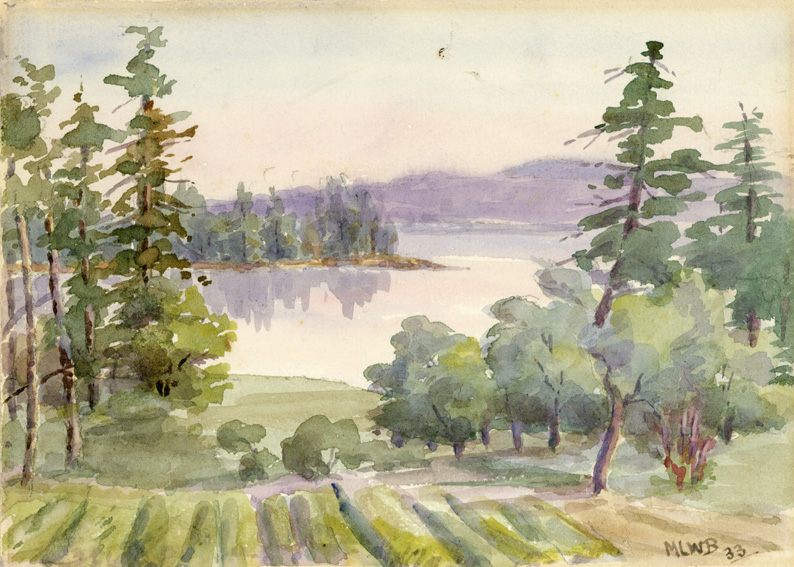
Maud was influenced by the Arts and Crafts Movement from an early age. Like her father, she became an avid landscape watercolourist, and was completely self-taught. She and her siblings were raised among the upper class of Victoria, and were given the freedom to run wild in nature for much of their upbringing.
Maud joined the Victoria Sketch Club at its origins in the 1890s (before it had been officially named), an art group that would travel all over Vancouver island to paint and sketch. Many of the members had ties to the Tyrwhitt-Drakes, such as the Creases, Pembertons, Wards, and Musgraves. Eventually, Emily Carr joined this group as well. Joining the Victoria Sketch Club was a popular pastime for aristocratic wives and ladies, who had the time and privilege to delve into the arts. With the other sketchers, Maud possibly travelled even farther than her father did in her lifetime: she painted sites all across Vancouver Island, interior BC, Northern Washington and later throughout America and Europe.
Maud married Arthur Weaver-Bridgman in 1890, who came to Canada in 1888 and became one of the first real estate agents on Vancouver Island. Arthur built them a home in Victoria on 766 Esquimalt Road, and later bought them land on Salt Spring Island. They went on to have three children, Gwennyd Jane, Montague Aurthur, and Jocelyn Clare. Arthur was a free spirit much like Maud, though they used to say that “if you sent him out to lunch he would be back three days later”. He and Maud had a relationship that was rare for the era: Maud was granted the freedom to continue travelling and painting as a wife, whereas most women were strictly confined to their homes and wifely duties.
The Weaver-Bridgman family introduced their lineage to Salt Spring in 1910, when Adolphus Trage sold his father’s original pre-emption to Arthur. The Bridgmans lived on the island for half of the year (the spring and summer) and in Victoria for the other.
Their new land was located in WENA,NEC (the South End, on Beaver Point). They named their home the Lyoness Cottage on Pooks Hill. The Weaver-Bridgmans were surrounded by a very close-knit indigenous community of Hawaiian and Indigenous men and women. Their neighbors on the Tsawout reserve were Chief Charlie and Mary Joseph (or Zalt Zalt), and early reports show that they developed a neighborly relationship, communicating in Chinook and buying fish from Charlie. This relationship eventually severed with the tragic disappearance of Charlie and Mary in 1923. Maud was friends with Lotus Ruckle (nee Menhinick) when she was growing up on the Menhinick property. Lotus was hired as a companion and housekeeper of Ms. Bridgman. Overall, they did not seem to avoid Indigenous friendships despite their societal differences. On the other side of their Salt Spring home - just a beach over - lived the King Family, where artist Sophie King would become popular for her driftwood sculptures. However, there is no record of a relationship between the Kings and the Bridgmans despite their close proximity.
Maud painted their views of Kingfisher Cove at least 200 times, filling her sketchbook pages with their home. Her children loved the island just as much as her, especially her son Montie. At this point in her life, family albums are filled with picnics, countless boating trips, and various travels.
The arrival of the First World War greatly affected Maud’s life. Montie left to serve overseas and did not return for about 10 years. Her daughters would soon be married off, and Maud would be widowed in 1918, when Arthur fell sick on a trip to Wales and did not return. Maud was left grieving and very alone, and though the family would still reunite for trips and boat rides, she would likely experience long stretches of solitude, where painting was her main pastime.
Maud’s only son, Montague Arthur Weaver-Bridgman “Montie” was born in 1898. He was born with a passion for the arts, like his mother and grandfather, but was the first to pursue it as a profession. Montie was primarily a sculptor and designer of Wedgwood pottery.
He loved Salt Spring Island like his mother did. There was one poem he wrote that was Maud’s favourite description of their home. His poem, written in 1928:
Summer
I love that western island with its purple legend height;
To hear the tide go whispering by on a breathless summer’s night,
With the far of splash of salmon as the seal goes after food
And the whistling wings of seabirds as they start their shoreward flight.
Autumn
I love that sunsoaked island with its hazy, blue-grey pall
From the acrid smoke of bush fires beyond the mountain wall,
The maples’ golden splendor reflected in the bay:
The geese are heading southward and the gull has changed his call
Winter
I love that little island when the tide goes booming past
With half a gale behind it and gulls are travelling fast
With a base note from the timber to swell the roaring from the creek
And the thudding scratch of driftwood as it comes to rest at last.
Spring
But best of all I love that island in the Spring
When life begins to murmur and love is on the wing
When the grouse begins his drumming to call his unknown mate;
‘Tis then I want to be there - ‘tis home and it is Spring
Montie was raised on Salt Spring Island, spending hours by the sea with his family. When WWI was announced, he left to serve in the RNVR. During his time there, he sketched scenes of the devastating war. Art was likely his escape in those traumatic times, as well as a tool used to cope in his future. Salt Spring Island was no doubt an escape as well, a peaceful safe haven on the sea. In 1939, Montie was pulled away to fight once more in WW2, this time as a Lieutenant-Commander with the Canadian Navy. He died young, at only 53 years old, from post-op complications.
Maud taught his daughter Rosemary how to paint with watercolours. Rosemary spent lots of time with her grandma Maud when going to art school in Victoria. Rosemary ended up choosing a career in education, however, she would go on to pass down her love of art to her daughter Briony Penn, great-granddaughter of Maud Weaver-Bridgman.
By the end of her life, Maud had made hundreds of paintings.
She was never considered a professional painter, though she dedicated her life to her art. She documented hundreds of natural landmarks on the West Coast with her vibrant brushstrokes. Her paintings are distinguishable by the loose, colourful strokes of her brush, and her dedication to studying our BC mountain ranges and ocean views.
She had never gone anywhere without paper and a paint palette, and would not hesitate to paint with tea if water was not available. Her free spirit is apparent by the sheer range of her collection, despite the other mysteries of her character. It is clear that she chose to see the beauty around her even when faced with life’s hardships.
Maud Weaver-Bridgman died in 1943 at 74 years old and was buried in the cemetery in Colwood, close to St. John’s Church in Victoria.

