Salt Spring Island Archives

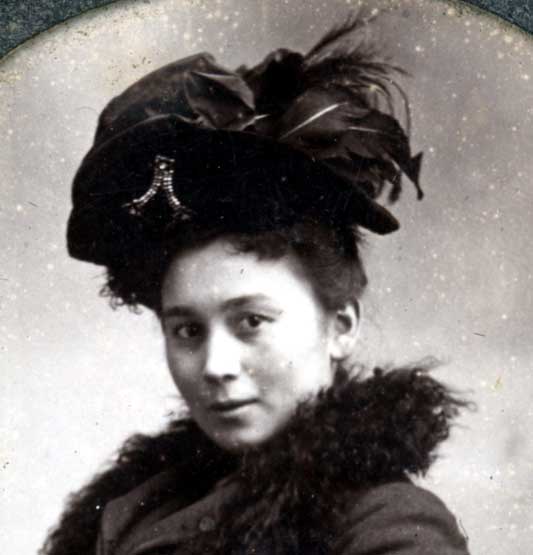
Sophie Purser was born in 1880 on Salt Spring Island by Annie Kollestomet of Cowichan, and Englishman George Purser. She was given to the Sisters of St. Ann Convent in Duncan as a young child, and was raised there, essentially an orphan. At age 17, she left to work in Victoria before returning to Salt Spring, where she married Leon King, raised a family, and built her signature driftwood sculptures until her death in 1975. Though she embodied proper and reserved demeanor, her free spirit is evident by her passion to learn new things and excel in them, even in her final decades. By all personal reflections, she was a soft-spoken woman, with confidence, grace, and an unwavering determination to find happiness in life.
Sophie was born on June 15, 1880, on the Purser’s Stowell Lake property, the second last child born of 7 (not including one half-brother).
Her mother was Sara Kollestomet, daughter of Loltemet (mother) and Sichamon (father), a Cowichan woman who was possible kin of Mary and Lucy Peatson. Her family connections are not clear.
She became Sara Fisher when marrying Edward Brande Fisher in January 1864. He pre-empted Piers island, and their son George was born there in June 1865. However, Edward died suddenly in 1865, only three months after their son’s birth. Sara was briefly accused of her husband's death, and baby George was taken to the Catholic order of Christian Brothers in Victoria. This was likely by the instruction of Edward Fisher’s mother after hearing of her son's untimely death.
Sara went on to marry George Purser in 1879. He was an English Magistrate, one of 12 children by Emma Suthington and Edward Purser. George came to Victoria in 1858 as a sapper (a military combat engineer) with the Royal Engineers. He was known as the “long-stocking Englishman” because he wore knickers and long stockings.
He officially changed Sara’s name to Annie Purser in marriage. Their children were: Mary Emma "Anna" Purser, Richard Purser, Robert Purser, Georgiana Purser, Sophie Purser, and George Purser. Annie had Sophie at approximately 23 years old.
By the time of Sophie’s birth, the Purser family was struggling to keep afloat. School teachers noted that they would see the Purser children come in without proper shoes and clothing. George Purser had developed from unknown causes a complete paralysis of the body, and his critical condition made it impossible to provide for the family, leaving them stranded and lacking the resources to properly care for the children or his illness.
This left his wife to provide for the family single-handedly. She would go to Victoria to do basic work, bringing baby Sophie along. Annie pulled her 16 year old son George Fisher away from his studies in becoming a Catholic Priest, needing his help caring for the younger children at home when she would go off-island for work.
In these dark times, Sophie’s older siblings watched as their mother eventually “gave up” on their father and left him. When Sophie was about 3, her father died by suicide. Annie Purser’s reaction to the death of her second husband is unknown. Sophie’s father was buried on their Stowell Lake property, which his step-son George Fisher inherited. Annie eventually returned to Salt Spring to support the children in the family home at Stowell Lake. Later, she went to live on Russel Island with Maria Mahoi and died there in 1908.
Sophie Purser was taken from her mother soon after the death of her father, who she never remembered nor saw a photo of. At 3 years old, Sophie was put into the Sisters of St. Ann Convent in Cowichan Valley. This was the doing of her half-brother George Fisher, it is not known whether he did it to help their mother Annie, or save Sophie from the broken family that she had been born into. Two of Sophie's older siblings Emma and Georgina were also brought to the convent later that year.
George took Sophie to the St. Ann Convent as an “orphan”, but they initially declined because of her young age. However, George was able to persuade the Sisters to take her in, making a deal to trade physical labour for her stay, specifically the cutting and splitting of 2,000 cedar shakes to roof a large barn for them.
It is possible that his upbringing in the Catholic Order aided him in this transaction, or was the reason they did not take her to the other indigenous children, despite her background. This decision possibly changed the entire course of Sophie's life. Instead of receiving a possible residential school education, she spent her time among the wealthier English/Irish girls who were “day-scholars”. She was taught skills like fancywork and embroidery. She wasn’t made to do any physical work; it did not seem that her status subjected her to the labour or maltreatment that other indigenous students historically experienced. However, she was often reprimanded or spanked for her stubborn behaviour, inability to say “sorry”, and her tendency to cause trouble. Sophie had no outside ties during this time. She was raised completely by the convent. The women there would call her “Sugar”, because she loved lots of sugar in her tea. Her outings would consist of small trips with schoolmates (such as fishing trips) or errands to run for the Sisters. They would choose her for errands because she was the fastest, though she explained later in life that it was because she would secretly take off her shoes to run.
At the age of 17, Sophie left the convent, though she never wanted to leave. Her wish had been to become a nun but she couldn’t afford the Habit, nor did the Sisters think the profession suited her. Instead, she went to Victoria to do domestic work, and did so for quite a few years, travelling to Tacoma and Seattle as well.
Her half-brother, George Fisher, found her in Victoria and then brought her back to Salt Spring to live with him and his wife, Maria Mahoi, on Stowell Lake. It had been decided that she should marry one of the eldest King brothers, Constantine or Alexander. However, both brothers drowned on the Triumph, a sealing ship that sank in the Bering Sea, tragically taking down many young Salt Spring men with it in 1904. Instead, Sophie married the youngest King brother, Leon, and made a good match with him. By this time she was about 24 years old.
Leon King explored many areas of work in his life. When he and Sophie married he was a logger with his own camp of employed men and horses. Later he became a fisherman, and would go to the Fraser River to fish. He also owned a dairy herd, and would supply cream to the Island Creamery. In the final years of his life he built boats. After marrying Sophie in 1904, he built their home with his own lumber on what is now Kings Road near King’s Cove. This was the property next to his fathers’, who had chosen waterfront land because it reminded him of his Greek homeland.
Leon was also an experienced violinist who could play very well by ear, and played at many dances on the island. Leon was said to be a wonderful soul, a very kind man to all who knew him. His grand-niece remembers how he would sometimes leave chocolate bars hanging on their kitchen door for the children.
Leon had a nickname “Big Bugger” that he got while fishing. The story goes that when he would only catch a single salmon in a day, he would lift it up to show it to other fishermen in their boats across the water, drop it and slide it across the deck with his feet, and pick it up with the other hand and say “there’s not many but they’re big buggers!”
Sophie and Leon’s marriage was a successful one. She helped him build their home, and they built at least 60 boats together: small launches and clinker boats, in their later years. They had six children: Hazel/Emma Jane, Zephira/Vera, Kenneth, Bernard, Evelyn/Violet, Clarence Leon/Lee.
Coming out of the convent, Sophie had been illprepared to take on the role of mother and wife. She herself reflected that she had relied heavily on Emma Stevens (Leon's half-sister, who was about a decade older than Sophie), rather than be the woman of her household. Sophie King spoke in her interview: “I was brought up that way, I was brought up by superiors you know and she [Emma] just managed me.”
Leon and his father both taught Sophie a great deal on how to raise a family, work the land, and gain the confidence she needed to run her home. They were successful in their goal; Sophie recalls enjoying that life immensely. She worked on the farm with her boys. She learned how to swim, and fish. Sometimes, Joseph King would watch the children so she could go fishing alone.
Sophie was connected with other indigenous wives on Beaver Point: the women of the South End were mostly indigenous, and cultivated a close-knit community that was a vital support in their confined lives as settler wives. Sophie was close with Emma Stevens, despite their contrasting personalities, and also spent time on Russel island with Maria Mahoi, who married her half-brother George Fisher.
Sophie was very content with her married life. With her children growing up and working on the farm, she stated that whatever the work, no matter how hard it was, she loved it. It was after her children left home and Leon passed away that she began to explore her interests in sculpture and woodwork.
Though she’d learned a variety of artistic skills throughout her life, such as oil painting, bone carving, and embroidery, she only had the time to make art a regular practice in her later years, and chose to focus primarily on woodwork. Using the skills that she had learned when boat building with Leon, she began collecting, carving, and painting the driftwood found in Kings Cove.
Her unique creations began to draw publicity as they spread out of her home into her garden and surrounding land. Hundreds of tourists would come to see her “driftwood museum”.
Sophie was adamant on keeping her works a collection, and never sold her works individually, though many asked to buy them. “Hundreds of tourists come to see my carvings every year. They beg me to sell some pieces in my collection, but I can’t bear to.” (Driftwood Article) She sold the collection as a whole to Bob Akerman, who promised to put all her art into his museum. Sophie’s work remained there until his passing. Most of the collection is now stored at the Salt Spring Archives.
