Salt Spring Island Archives

Nihil Magnum Nisi Bonum
Kyrle C. Symons
The Story of St. Michael’s School, Victoria, B.C.,
from 1910-1948
1908-1910 — Pre-School Days
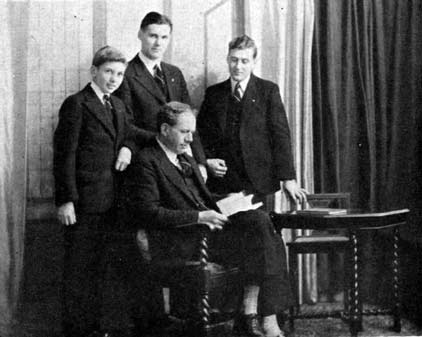
Before we enter the main hall, there is a little ante-room in which I would show you one or two sketches. It is only a very humble little room — about two years in length— but I spend much time there, and here are some of the pictures I see.
A young man and his wife arriving in Victoria; they have little except each other, but that is great riches. He is a teacher, the son of a teacher, and has the idea of starting a little school of his own. They both have always felt the urge to go West—the early history of England is a series of whole peoples coming Westward across Europe like waves, to her shores—and here they are, met by an old cousin, as far West as they can go, till the final Westward journey. Almost at once the man is taken ill and the small capital dwindles, but the faith remains.
So here he is in August before the Superintendent of Education, seeking a position in the Public Schools of British Columbia. Dr. A. Robinson receives him kindly and asks him his qualifications. Then, turning to his stenographer, a pretty girl in a white frock, he says, “Shall we let him try Beaver Point?"
He hires a launch from Sidney with a few of his remaining dollars, which he still finds rather difficult to understand, and goes to Beaver Point, on Salt Spring Island, to interview the Secretary. (I think one's first view of the Gulf Islands on a perfect day is well worth six thousand miles of travel. It is a paradise—blue sea, mountains, an occasional seal, sea birds galore, the “put-put” of a Japanese fisherman's boat; and I have been an Islander at heart ever since I)
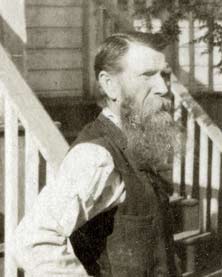
Here he is trudging along a dusty road, by the side of an old buck-board in which sits the said Secretary—an oldish Scotsman with a red beard and a most disreputable hat— who takes him to his farm, obviously to be sized up by “Mamma";—he decides that the man will do and arranges to take him and his wife as boarders in “the room."
August 25th, the first day in School—a modest little one-room building in a forest clearing—where he is scrutinized by some dozen little Canadians of various nationalities, all wondering about the strange Englishman—who in his turn is wondering how he will handle Grades I to VIII, and yet keep them all occupied; and so they settle down to work.
(I note already lapses in literary composition; the pronouns “he” and “I” are getting a bit involved and now comes “we” — which I prefer. I offer apologies and suggest that you look at the pictures rather than the pronounsl)
In September a good friend, Mr. J. Monk, most kindly offered us a tiny, primitive log hut — built by a Kanaka— where we made our first home—a very happy one—and into it we welcome our first little son. He was born November 22nd, in the house of Mrs. Beddis, near Ganges; she with her daughter, did everything for us at a somewhat difficult time—and her grandson years afterwards attended the School.
The return “home” in December was in its way an Odyssey. It was a bad day, very wet, and with a rising wind. Mrs. Beddis saw us into a small row-boat I had borrowed; hot bricks were put on the floor and a shapeless bundle of rugs, etc., that was my family, was installed in the back. We rowed to the Bulman saw-mill, now no more, where the foreman boosted them up a steep ladder to a little cottage. Here a short rest and some hot cocoa did wonders. The next step was to board the old steamer Iroquois — which not long afterwards was lost with many good lives. On it we reached Beaver Point wharf in a gale and deluge. Here another good friend, still my good friend, Mr. Ruckle, lent us a horse and buggy and we drove home, avoiding falling branches with more luck than skill. There Mrs. Monk had a nice fire going, and took charge—while I drove the “carriage” back in pitch darkness—finally returning to a little scene which I can only leave you to imagine.
The tiny hut, with a white-washed board partition in which was an opening — no door — to the bedroom, the main furnishings of which were empty apple boxes; an equally tiny kitchen, with a table and 2 hard chairs — a little stove burning cheerfully, and a lamp doing its best— mother and child (duly bathed and asleep) waiting for the return of “Daddy.” Does one easily forget such a day?
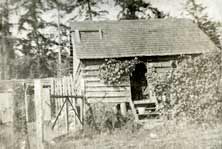
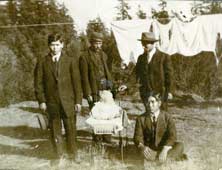
Such happiness was inside those log walls. If the window was short of glass and a vine poked inquisitively through the opening, it certainly kept out some weather and was quite ornamental. Mr. Monk had some Japs working for him, and they used to come to me at night, to learn to read from an infant's Reader; in return they used to cut and stack a fine lot of fire-wood for us every Sunday. They were deeply interested in the baby. I have snapshots of all these people and things, and very precious they are.
Looking through the diaries I have kept all the time, I see we had our first experience of a “cold snap” in January, 1909—that school was closed, that I learned to pluck and clean chickens, that we bought 45 lbs. of beef from a neighbour at the modest price of 90c—(take note, ye butchers of today!), that we took our baby for a little walk in deep snow, that we attended various services of all denominations in the school house — and that finally we arranged with senior Mr. Ruckle, a grand old pioneer, to rent from him a piece of his property known as the “Pea Vine.” This consisted of 160 acres — mostly trees — an orchard — a little cleared ground — a barn and another little log cabin, also built by a Kanaka, that is a man from the South Seas, of whom there had been a few on the Island. When I inquired the rent Mr. R said “Would $4.00 a month hurt you?” As I was drawing the princely salary of $42.50 a month, we felt we could manage this and made preparations for our first move.
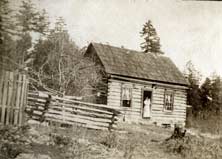
The cabin had stood empty for a long time; but I used to go up daily after school with a most devoted and excellent school boy, Dimitri Stevens, now a guard at Banff, and work at it. Having scraped bats off the walls and filled up the chinks with moss, etc., we pasted on the walls coloured pictures from various magazines sent us from home and really made the place quite cheery. Mr. A. Ruckle fixed up the door and windows—and made us a rough sideboard and table. I made a magnificent cot for the little boy, out of some old table legs that I found in the barn! For a mattress we sewed up an old blanket into a bag, filled it with hay — also from the barn —and never had a princeling such a bed!
There was at some distance from the house, a spring of really good water—which we cleared of accumulated leaves, mud and foreign bodies—and this was our cistern. I manufactured buckets out of empty coal-oil tins and went daily for the water supply, invariably accompanied, as” soon as he could toddle, by my little son who kept his tiny hand on one bucket and thought he was carrying it. At any rate he was helping.
No fuel bill for us: There was wood in abundance all round. Greatly daring, we now bought a cross-cut saw to fell our trees and I flatter myself that for a man and wife just out from busy English towns we made surprisingly good loggers. We would wheel the baby in his folding buggy to a safe spot, and then, one at each end of the saw, attack our tree, which obligingly fell just where it was wanted. Then it was sawn into drums which were rolled into a collapsed chicken house that made a good woodshed — and there split up with wedges and a heavy sledge hammer. I well remember having some thirty of these round the wood shed and coming back from School to find that “she” had split every one. It was not many days later that our second son was born! Next we broke into chickens—bought twelve Black Minorcas and were presented with a fine Rhode Island Red rooster. Marvellous creatures, they did their duty, each and every one of them, and kept us abundantly in eggs. One day there were thirteen, and we believed that the rooster was doing his bit to keep us well supplied.
Finally there was the garden. We dug up a big patch of the open ground below the orchard and even now I see that wonderful Edith of mine pushing the buggy with one hand and with the other dragging long pieces of split cedar from an old “snake fence” which we discovered. We made it high to keep out the deer and it must have resembled one of the old stockades built to resist Indian attack. We bought a “monster” packet of various seeds from T. Eaton — planted them and very many potatoes. Soon we had an amazing crop of every kind of vegetable — even to “squashes,” which we had never seen and which caused us some surprise when they appeared.
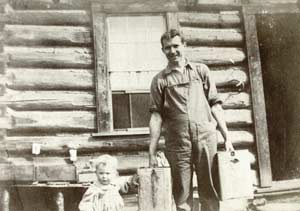
The baby and I fetched the milk every night — a good two-mile walk — he sitting in a sling draped over my shoulder and making pleasant conversation.
I had a gun — but no license — which I used to carry to school and hide behind an old harmonium in the corner. With it I bagged the odd grouse (usually sitting) — occasionally a friend might bring us a piece of venison. A farmer generously gave me some liver for helping him stack hay in his barn. And for Christmas we really cut loose and bought a leg of mutton from Victoria. So you see we did not starve, and my wonderful wife could have cooked a pair of boots and made them palatable.
One story of the gun. While I was at school a very large chicken hawk — or fish eagle — appeared circling round the chicken pen. With great presence of mind Edith loaded the gun and fired at the marauder — or in its direction. Then, and not till then, did her nerve fail her. She hurled the gun from her — dashed inside and locked the door. How often we laughed over that!
Now appears the second little son — under the magnificent management of a little nurse, Miss Bulman, clearly sent by Providence to take care of the growing family. No doctor was available — nor necessary. So far as I can see she never closed her eyes for days on end, but when the business was all over she burrowed out of sight under her bedclothes and slept and slept and slept. She will always have my loving gratitude.
I'm afraid there are more pictures than you bargained for — and even so you have not had the half of it — but we're nearing the end of the first gallery and I'll ask you to look at just one more.
I am splitting wood from a charred tree (covered with soot and thoroughly disreputable). Up the path from the road comes a young girl in a white coat and a smart young man. She asks, “Are you the teacher?” and I have to admit the fact. “My father,” she says, “has built a summer home down by the sea and wants you to coach my young brother during the holidays."
Here it is — the great moment — my first private pupil. The lady is now Mrs. John Grant and I am proud to be allowed to call them friends. The father was Mr. A. W. Bridgman, who, we might say, was our founder. The boy is now Lt.-Com. M. W. Bridgman, as ever a firm friend and ally.
Now you see why I have taken you round these pictures and what they were all leading up to. Both the father and mother were utterly charming and kind — and arrangements were soon made. He nobly offered me fifty dollars a month, a considerable “raise.” During July and August I used to go down to their very nice house, often with the big baby. There (in a little room at the back) Monty and I plunged into “Elementa Latina.” Those portraits will hang on the walls of memory as long as I last.
The holidays end and Mr. Bridgman suggests that we move into Victoria and carry on — saying “I'll see you through,” and you'll see later that he certainly did so. So it was decided. Mrs. Bridgman secured us a tiny house (but a house this time) on Catherine St. in Victoria West—a minimum of furniture was secured and we moved in (having first removed the coal from the bath where it evidently had been kept previously).
Here I should like to pay my tribute to the Department of Education. In order to teach in the Public School one must have a Certificate. They were good enough to give a temporary one—for my first year—but in July I had to take their examination in order to be a “proper” teacher. What day that was! It was our wedding anniversary to begin with. We boarded the old “Iroquois” at the wharf and while backing out from Bedwell Harbour, her next stop, she ran on a rock and smashed her steering gear. Capt. Sears promptly called out to a young man who was working on a launch close by, “Tom, I want your father to take the passengers to Sidney” and in a few minutes the launch came alongside and we were transferred. It was a crowd to put it mildly; the women and babies were shut up like sardines in the cabin. Men stood in the little pilot house—men stood on the little deck at the stern—the steward and I laid ourselves on the cabin roof with the suitcases, of which we were allowed one—and off we went. As soon as we were out of the harbor we ran into very bad weather. The boat plunged and rolled so that we had to run a rope through all the handles of the suitcases to prevent them from falling overboard. The rest of us hung on to anything we could. It really was a bad journey, but the engine, mercifully, did not miss a shot and eventually, at about six, we reached the little town of Sidney. Here quite a crowd had assembled and kindly hands armed us out onto terra firma which quite frankly I had not much expected to see again. Most of the babies, and consequently the women, had been violently sea sick; and they were all definitely the worse for wear. I consider we all owe our lives to Mr. L. S. Higgs, owner, builder and pilot of the launch. The old train that used to run (optimistic word) to Victoria, known as the “Cordwood Flier,” had waited for us and ultimately we reached the city and found a comfy room in Amelia St. The next day I had my exam. The Department was good enough to give me the Academic Certificate—and soon after that we got back to the beloved Island and home once more.
And so farewell for the time being to Beaver Point—the little school house—the little log cabin—the woods—the winding country road—and many good friends who are to this day my friends and whom I visit whenever I can. We recall the early days when I was a very green young stranger and they took me in.
That, ladies and gentlemen, concludes an all too rapid survey of our ante-room. Now we enter the main gallery and start the, to me, amazing story of St. Michael's School, founded in 1910.

